How to Fix the Lead-Follow Connection That Makes Turns Feel Like Guessing
Quick Answer: Connection in salsa is a specific, constant, moderate tension in the arms, roughly the amount needed to hold a full cup of coffee steady. Too loose and the lead’s signal never arrives. Too stiff and the signal cannot be distinguished from the tension already there. Most connection problems are actually elbow problems: elbows that lock straight or collapse against the ribs both destroy the ability to transmit or receive information, regardless of how good the footwork is.
This is why practising alone can make you technically excellent and still lost the moment you take a hand.
This blog has covered why your salsa turns feel fine alone and fall apart with a partner, why your footwork tightens the moment someone watches, and why your shoes change your balance more than technique. This is the connection version, which is the one that unlocks partner work.

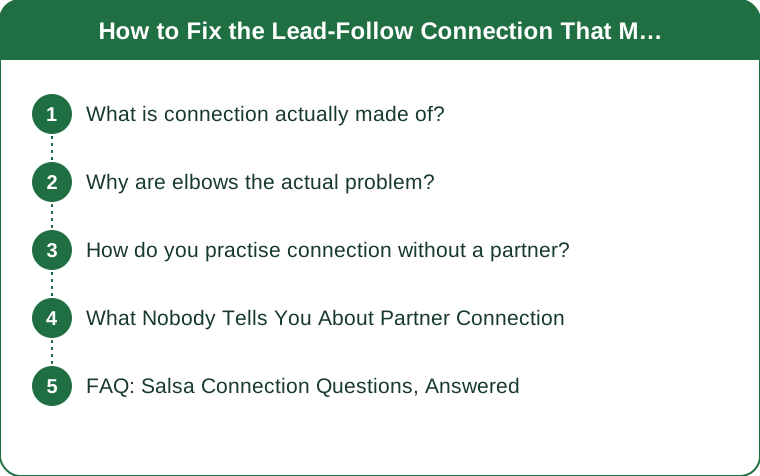
What is connection actually made of?
A constant, moderate, springy tension that lives in the arms and is generated from the back.
Think of it as a firm spring, not a rope and not a rod. A rope transmits nothing until it goes taut, which means the signal arrives late and abruptly. A rod transmits everything instantly, including all the noise, which means the follow cannot tell a lead from a wobble.
The right amount is roughly what you would use to hold a full cup of coffee steady while walking. Enough to control it, not enough to crush it. This is the most useful physical reference point in partner dancing.
It has to be constant, not intermittent. Connection that appears only when a turn is being led means the follow gets no information at any other time, including the information that no turn is coming.
It comes from your back, not your hands. Gripping with your hands and fingers produces stiffness. A gentle engagement of the muscles between your shoulder blades produces tone through the whole arm without any grip at all.
Both partners contribute. A follow with no tone gives the lead nothing to move, and a lead with no tone gives the follow nothing to read. This is a shared responsibility and it is very frequently attributed entirely to one side.
And it changes with the move. A cross-body lead needs different tone than a hand-behind-the-head turn. The baseline stays similar; the fine adjustment happens continuously.
Why are elbows the actual problem?
Because the elbow is where connection is either preserved or destroyed, and almost nobody looks at it.
Locked straight elbows turn your arm into a rigid rod. Every movement of your body travels directly to your partner, including the ones you did not mean to send. Follows describe this as being yanked, and leads describe the follow as unresponsive, and both are describing the same locked elbow.
Collapsed elbows pinned to the ribs remove your arm from the equation entirely. The connection now runs through your torso, which means you have to move your whole body to send a signal. This produces the shoving quality that makes some partners exhausting to dance with.
The working position is elbows slightly forward of the ribs with a soft bend. Roughly a fist’s width away from your body, never straight, never pinned. From here your arm can both absorb and transmit.
Elbows should stay in front of your torso plane. When an elbow travels behind your body, you lose all ability to control the connection and the shoulder takes over, which is where most partner dancing shoulder pain originates.
Practise the position without music first. Stand facing a wall, put your palms on it at chest height with soft elbows, and press gently. That is the tone. Notice how it feels in your back rather than your hands.
Check it in the mirror during your solo practice. You can build the arm position alone, and the people who do arrive at partner work with a working connection already installed.

How do you practise connection without a partner?
Several ways, and they work better than most people expect.
Use a doorframe or a resistance band anchored at chest height. Hold light tension and move through your basic steps while maintaining a constant pull. If the tension varies as you step, your connection would be varying with a partner.
Practise the coffee cup test literally. Hold a full cup in each hand and do your basic and your turns. Spilling means your tone is changing or your arm is moving independently of your body when it should not be.
Work on maintaining frame through your own turns. Turn slowly with arms in position and notice where your frame collapses. For most people it is at the halfway point of the turn, where the arms drift behind the body plane.
Record yourself from the front. Arms are one of the things you genuinely cannot see while dancing, and almost everyone is surprised by the footage the first time.
Practise the arm position while doing nothing else. Sitting on the sofa, hold the position for two minutes and notice which muscles fatigue. If it is your hands and forearms, you are gripping. It should be the mid-back.
And practise moving your body without moving your arms relative to your torso. Arms that stay in a fixed relationship to your ribcage while your ribcage moves is the underlying skill in essentially all partner dancing.
What Nobody Tells You About Partner Connection
Different partners genuinely need different amounts of tone, and adjusting is a skill in itself. A stronger, larger partner and a smaller, lighter one need noticeably different tone from you. Good social dancers recalibrate within the first eight counts of a song, and that recalibration is most of what makes someone feel good to dance with.
Being clear is kinder than being gentle. A lead so soft it cannot be read is not considerate, it is confusing, and it makes the follow feel like they are failing when they are receiving no information.
Follows are not passive and the language obscures this. A follow maintains their own frame, their own balance, and their own axis. A follow who goes completely limp is far harder to dance with than one who is slightly too firm.
Most turn problems are balance problems wearing a connection costume. If you cannot turn cleanly alone, no amount of connection work fixes it with a partner. Solo spotting and balance drills are prerequisites, not alternatives.
Shoes change your connection because they change your balance. A shoe that leaves you slightly unstable causes you to unconsciously use your partner’s arm for support, which corrupts the connection entirely. This is the mechanism behind the shoes-matter observation.
And connection is what people remember. Nobody at a social dance remembers whether your footwork was precise. They remember whether dancing with you felt good, and that is almost entirely connection.
FAQ: Salsa Connection Questions, Answered
How much tension should there be in salsa connection?
Roughly the amount needed to hold a full cup of coffee steady while walking. Enough tone to transmit and receive information, not enough to be stiff. It should feel like a firm spring rather than a rope or a rod.
Why do my salsa turns work alone but not with a partner?
Usually connection rather than technique. If your arms have no consistent tone, the lead’s signal never reaches you, and if they are locked straight, the signal cannot be distinguished from the existing tension. Check your elbows first.
Where should my elbows be in salsa?
Slightly forward of your ribs, roughly a fist’s width away, with a soft bend. Never locked straight and never pinned against your body. Elbows travelling behind your torso plane is where most connection and shoulder problems start.
TL;DR:
- Connection is constant moderate tone, about what it takes to hold a full coffee cup steady. Not a rope, not a rod.
- Elbows are the actual variable: soft bend, a fist’s width from the ribs, always in front of your torso plane.
- Generate the tone from between your shoulder blades, not by gripping with hands and forearms.
- Practise alone with a resistance band at chest height, and film yourself from the front. You cannot see your own arms.
Being clear is kinder than being gentle. A lead too soft to read makes the follow feel like they are failing.
Keep Reading
This article is for general informational and styling purposes only. Fit, sizing, and product availability may vary.