Why Most Salsa Beginners Are Actually Counting the Wrong Beat From the Very First Class
Quick Answer: Salsa music runs in 8-count phrases, but the basic step only lands on 6 of those counts — you step on 1-2-3, pause on 4, step on 5-6-7, pause on 8. Beginners who step on every beat shift their whole count forward by one, which puts every following step off-time with the music and their partner. Practicing the pause out loud, alone and slowly, is the fix.
You can hear the music. You can do the steps. And somehow, three bars in, you’re fighting your partner and the song at the same time.
It’s almost never a coordination problem. It’s a counting problem — and specifically, it’s about two beats you’re supposed to not step on.
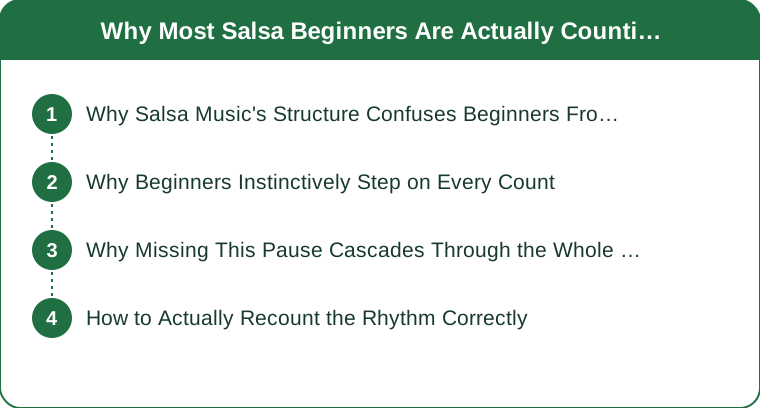
Why Does Salsa’s 8-Count Confuse Beginners?
Because the music gives you 8 beats and the dance only uses 6 of them.
A salsa phrase is built on 8 counts. The basic step takes 3 weight changes, holds, then takes 3 more, and holds again. In practice that means you step on 1, 2, 3, hold 4, step on 5, 6, 7, and hold 8.
Those two held counts are not rests in the music — the music keeps going. They’re rests in your feet. That mismatch between what you hear and what you do is the single most common source of beginner confusion, and almost nobody explains it in the first class because the instructor is busy teaching the footwork.
Why Do Beginners Step on Every Beat Anyway?
Two reasons, and both are perfectly reasonable instincts.
The first is transfer from other dances. If you’ve done ballroom, hip hop, or most partner styles, you’ve been trained that a beat is an invitation to move. Salsa asks you to override that on 4 and 8, which feels wrong for weeks.
The second is simpler: when music has a steady pulse, bodies want to match it. Standing still on a beat while the percussion carries on is genuinely counterintuitive, so the foot goes down almost before you decide anything.
Then there’s the counting habit itself. Plenty of beginners count “one-two-three, one-two-three” like a waltz, which fits the footwork but not the music — and the moment you try to sync with a partner, the phrase boundaries don’t line up.

Why Does One Missed Pause Wreck the Whole Pattern?
Because the error doesn’t stay put. It travels.
Step on count 4 instead of holding it, and every subsequent step shifts forward by exactly one beat. Your “1” now lands on the music’s 2. Nothing feels catastrophically wrong at first — you’re still moving rhythmically — which is precisely why it goes unnoticed.
But your partner is on the real 1. So the lead arrives a beat early, the turn is signalled before your weight is ready, and both of you start compensating. Most “bad lead” and “bad follow” complaints at the beginner level are actually one dancer being a single beat offset.
It also gets harder to fix over time. A month of practicing the shifted count means your body has learned the wrong thing well, and unlearning takes longer than learning did.
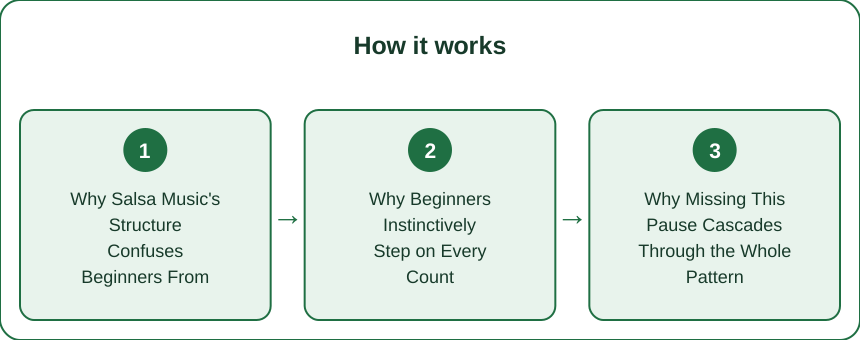
5 Mistakes Everyone Makes With Salsa Timing
1. Counting 1-2-3 instead of 1-8. The footwork is a 6-step pattern, but the music is an 8-count phrase. Count all eight out loud, even the ones you don’t step on, or you’ll lose the phrase every time you turn.
2. Learning the pause with a partner instead of alone. With a partner, you can be dragged onto the right beat without ever internalizing it — which collapses the moment you dance with someone else. Fix it solo first.
3. Practicing at full speed. Typical salsa runs 180 to 200 beats per minute, which is far too fast to correct a habit. Practice at roughly half tempo until the pause is automatic.
4. Ignoring the clave and the bass. The bass usually hits hard on 1, and once you can find that anchor by ear you can re-enter the phrase after any mistake. Dancers who can’t hear the 1 spend the whole song hoping.
5. Silently counting in your head. Counting out loud is embarrassing for about four minutes and then it’s the thing that fixes you. The vocal pause on 4 and 8 is what trains the foot to wait.
The third one is the one that surprises even people who’ve been dancing for a year — they’ve simply never practiced slow enough to hear their own error.
How Do You Actually Fix the Count?
Do this alone, in a kitchen, with no partner and no pressure.
- Put on a slow salsa track or a metronome at about 90 to 100 BPM — roughly half of social dancing speed.
- Count out loud: “one, two, three, pause, five, six, seven, pause.” Say the word “pause,” don’t just leave a gap.
- Step the basic while counting. Forward on 1, replace on 2, back to center on 3, hold on 4. Then back on 5, replace on 6, center on 7, hold on 8.
- Do it for 5 minutes a day, not an hour once a week. Timing is a habit, and habits respond to frequency.
- Then speed up gradually — add about 10 BPM only once the current tempo feels boring.
Within a week or two, the pause stops being something you think about. That’s the entire goal: not counting better, but not needing to count at all.
Mini FAQ
What are the actual counts in salsa?
The basic uses 1-2-3 and 5-6-7 for steps, with counts 4 and 8 held. On1 style begins the forward break on count 1; On2 shifts the break to count 2, but the six-steps-two-holds structure stays the same.
Why do I keep losing the beat mid-song?
Usually because you can’t independently find the “1” by ear, so any small error compounds with nowhere to reset. Practice listening for the bass or the conga hit on 1 without dancing at all — it’s a separate skill worth ten minutes a week.
Should beginners learn On1 or On2 first?
On1 is generally easier to hear and is the most widely taught, so most beginners start there. What matters far more than the style choice is that you’re consistently holding two counts rather than stepping through all eight.
TL;DR:
- Salsa music has 8 counts; the basic step uses only 6, holding 4 and 8.
- Stepping on a held beat shifts your entire count forward by one, off-timing everything after it.
- Most beginner “partner problems” are actually a one-beat offset.
- Fix it solo, out loud, at half tempo — 5 minutes daily beats one long weekly session.
- Learn to hear the bass on 1 so you can reset mid-song instead of guessing.
The pause isn’t a gap in the dance. It’s the part that makes the dance line up with the music.
Keep Reading
This article is for general informational and styling purposes only. Fit, sizing, and product availability may vary.