Why You Keep Losing the Beat in Salsa (It's Not Your Rhythm)
Quick Answer: Most beginners lose the salsa beat because they’re counting the music’s downbeat instead of the clave rhythm underneath it — learning to hear the clave pattern fixes timing faster than more practice on the basic step alone.
You’ve drilled the basic step at home a hundred times, and the second the music starts at a social, you’re off by a full beat within four counts.

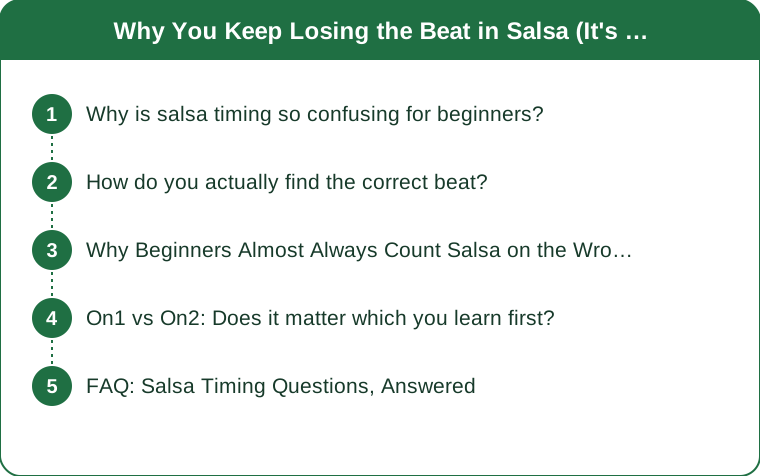
Why is salsa timing so confusing for beginners?
Salsa music has two rhythmic layers: the obvious drum beat you naturally nod along to, and the underlying clave pattern that the dance steps actually follow. Most beginners lock onto the wrong layer, which is why the count feels right in a quiet room but falls apart with a full band playing.
This isn’t a lack of rhythm — it’s listening to the wrong part of the music, which is a learnable skill, not a talent.
How do you actually find the correct beat?
Listen for the conga or bass pattern rather than the horns or vocals — the horns often play syncopated melodies that mislead your counting. Practice counting out loud ‘1-2-3, 5-6-7’ (skipping 4 and 8, the pause beats) along with a song before you even move your feet.
Once you can count correctly while standing still, add the basic step — trying to learn both at once is what causes most of the early confusion.

Why Beginners Almost Always Count Salsa on the Wrong Beat at First
It’s genuinely common — even experienced dancers from other styles often misplace the salsa beat initially because most Western pop music emphasizes counts 1 and 3, while salsa’s break step often lands differently depending on ‘on1’ versus ‘on2’ style. If you’ve been dancing to pop music your whole life, your ear is trained for a different emphasis pattern entirely.
The fix is deliberate re-training: isolate the clave sound in a song (many practice videos isolate it) and count along until it clicks, usually within a few focused sessions.
On1 vs On2: Does it matter which you learn first?
‘On1’ style breaks on count 1, which is more common in casual social salsa and often easier for beginners to internalize since it aligns with the strong beat. ‘On2’ style breaks on count 2, common in some studio and ‘mambo’ styles, and tends to feel more advanced once you have it.
Most beginners are better served starting with on1 for social dancing, then adding on2 later if they want to dance in more studio-style scenes — trying to learn both simultaneously slows progress.
FAQ: Salsa Timing Questions, Answered
How long does it take to hear the beat correctly?
Most beginners who practice counting deliberately (not just dancing) get it within 3-5 focused sessions, though social dancing comfort takes longer.
Should I learn on1 or on2 first?
On1 is usually the better starting point for social dancing since it aligns with the strong beat most people hear naturally.
Can I learn timing without a partner?
Yes — and it’s actually recommended; counting and stepping alone to music removes the pressure of also following a partner while you build the foundation.
TL;DR:
- Beginners often count the wrong rhythmic layer, not lack rhythm
- Practice counting ‘1-2-3, 5-6-7’ out loud before adding footwork
- On1 is usually the easier starting style for social dancing
- Isolate and listen to the clave pattern specifically to retrain your ear
Give your ear a few dedicated counting sessions before your next social — it fixes more than another week of solo step drilling.
Keep Reading
This article is for general informational and styling purposes only. Fit, sizing, and product availability may vary.