The Frame Tension Mistake That Ruins Your Salsa Turns (It's Not Your Feet)
Quick Answer: Wobbly or off-balance salsa turns are usually caused by a stiff or floppy frame (arm tension), not footwork. Keep a firm-but-relaxed arm connection and your spins stabilize almost immediately, regardless of foot placement.
You’ve drilled the footwork for your basic turn a hundred times and it still feels off-balance or gets yanked around by your partner. Before you blame your feet again, check your arms — frame tension is the far more common culprit, and it’s a much smaller fix than relearning footwork.

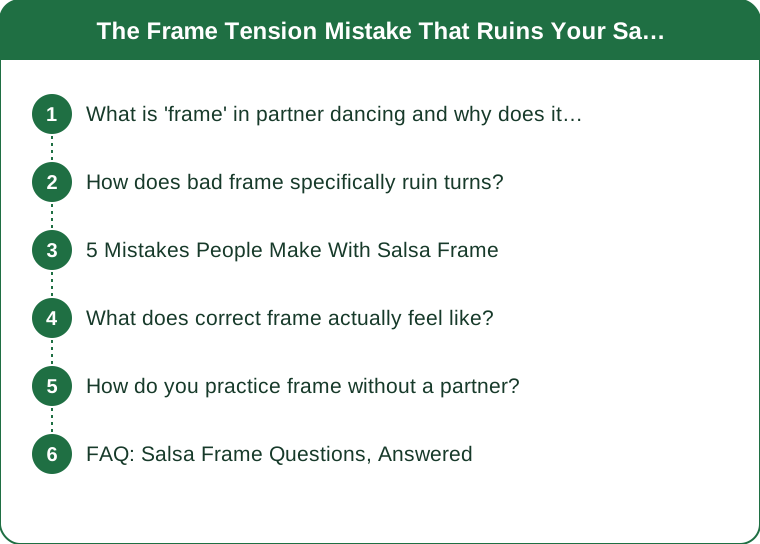
What is ‘frame’ in partner dancing and why does it matter?
Frame is the tension and shape held between your arms and your partner’s — think of it as the steering wheel of the connection. Too stiff and you fight every lead; too floppy and your partner has nothing to actually steer you with. Either extreme throws off your turns regardless of how clean your footwork is.
The right amount feels like holding a bird: firm enough it doesn’t fly away, gentle enough you don’t crush it.
How does bad frame specifically ruin turns?
A floppy frame means the lead’s signal (a slight push or rotation through the arm) arrives late or gets absorbed before it reaches your body — so you’re always a half-beat behind and compensating with your feet, which reads as ‘off-balance.’
A too-stiff frame does the opposite: it transmits every micro-adjustment as a jerky yank instead of a smooth rotation, which is the sensation most beginners describe as ‘getting spun too hard.‘
5 Mistakes People Make With Salsa Frame
1. Locking the elbow straight. A locked elbow transmits force too directly and too suddenly — keep a soft bend always.
2. Gripping the hand too tight. This tenses the whole arm up the chain; a lighter grip actually improves signal clarity, not just comfort.
3. Dropping frame entirely during the turn itself. Many dancers hold good frame until the turn starts, then let the arm go slack mid-spin — that’s exactly when you need it most.
4. Copying frame tension from a much stronger or weaker partner. Frame calibrates per-partner; what worked with one lead may be wrong with another.
5. Focusing entirely on foot placement in lessons. Footwork drills are important but frame is the connection layer most classes under-teach relative to how much it actually fixes.

What does correct frame actually feel like?
Both partners should feel a constant, gentle resistance — like pushing lightly against a partially inflated balloon. If you can move your partner’s arm without them noticing, frame is too loose. If either of you feels strained or achy after a song, it’s too tight.
How do you practice frame without a partner?
Hold your arm out and have a friend (or even a doorframe edge, lightly) apply gentle, varying pressure while you try to maintain constant resistance — not stiff, not collapsing. Five minutes of this awareness drill translates directly onto the dance floor faster than most people expect.
FAQ: Salsa Frame Questions, Answered
Is frame the same for open and closed salsa positions?
The principle (firm but relaxed) stays the same, but the actual arm shape changes — closed position needs more shoulder engagement, open position relies more on hand-to-hand connection.
Why does my frame feel fine with my regular partner but bad with someone new?
Frame calibrates to a specific partner’s strength and lead style over time — this is completely normal and just means you need a few songs to recalibrate with someone new, not that you’re doing it wrong.
Can too-strong frame cause injury?
Overuse strain in the shoulder or wrist is possible with chronically locked or overly tense frame over many social dancing hours — if you feel ongoing soreness, ease your tension and check with an instructor on your form.
TL;DR:
- Off-balance salsa turns are usually a frame problem, not a footwork problem
- Frame should feel like holding a bird — firm enough to hold, gentle enough not to crush
- Locked elbows and death grips transmit force too harshly; a soft bend and light grip work better
- Frame recalibrates per partner — that adjustment period is normal, not a sign of bad technique
Next time a turn feels off, check your arms before you blame your feet.
Keep Reading
This article is for general informational and styling purposes only. Fit, sizing, and product availability may vary.