Why Beginners Almost Always Count Salsa on the Wrong Beat at First
Quick Answer: Salsa music is built on an eight-count musical structure, but the dance itself breaks on specific counts (typically 1, then pausing on count 4, or on count 2 depending on style) rather than starting movement on the first audible beat — new dancers instinctively start stepping on beat one because it’s the most obvious accent in the music, when the actual dance timing often calls for starting differently.
The most audible beat in the music and the beat you’re actually supposed to step on aren’t always the same beat, which is the root of almost every early counting mistake.
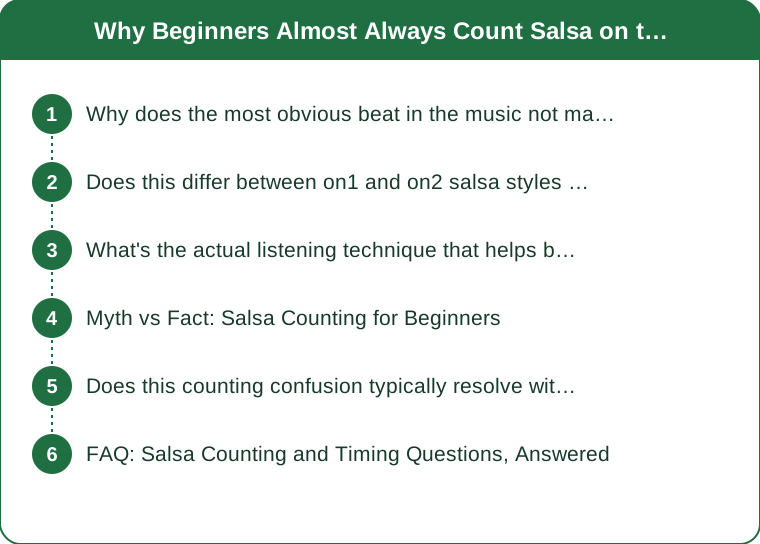
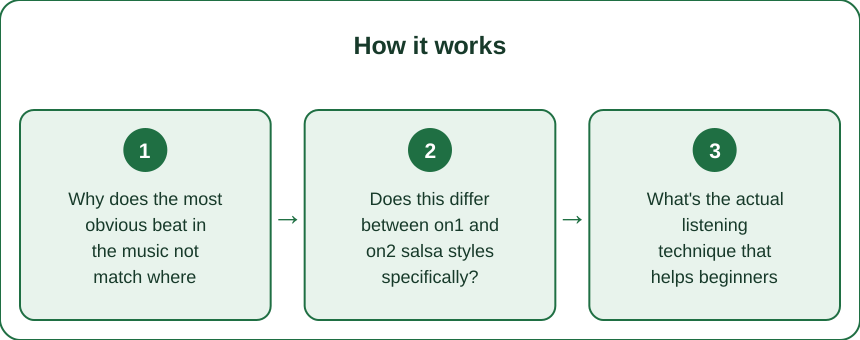
Why does the most obvious beat in the music not match where you’re supposed to step?
Salsa music’s underlying instrumentation, particularly the clave rhythm pattern, creates several audible accents across the eight-count structure, and the beat that feels most naturally emphasized to an untrained ear (often the downbeat, count 1) doesn’t always align with where a specific salsa style’s basic step pattern actually begins or pauses, which is disorienting until the ear learns to listen for the right structural cue rather than just the loudest one.
Does this differ between on1 and on2 salsa styles specifically?
Yes, significantly — on1 style breaks (changes direction) on count 1, aligning more closely with the instinctive downbeat feel, while on2 style breaks on count 2, which is a full beat later than most beginners’ natural instinct, making on2 timing noticeably harder for many new dancers to internalize at first even though both styles use the same underlying eight-count music.
What’s the actual listening technique that helps beginners find the correct count?
Rather than trying to count music generically, learning to specifically listen for the clave pattern or the more consistent conga/bass pattern underlying a salsa track, and practicing counting out loud along with a slowed-down or familiar practice track, trains the ear to locate the actual structural counts rather than just reacting to whichever instrument sounds loudest in a given moment.
Myth vs Fact: Salsa Counting for Beginners
Myth: if you can hear the beat, you’re already counting correctly. Fact: hearing a beat and identifying the correct structural count for your dance style are different skills — accurate counting takes deliberate practice beyond general rhythm sense.
Myth: counting out loud is something only total beginners need to do. Fact: even experienced dancers count internally or out loud when learning new patterns or adjusting to unfamiliar music, since it’s a genuinely useful technique at every level, not a beginner crutch to abandon quickly.
Myth: getting the count wrong means you have no natural rhythm. Fact: miscounting the specific structural beat is a near-universal early experience regardless of general rhythm ability, since it’s a learned skill specific to the music style, not a reflection of overall musicality.
Does this counting confusion typically resolve with more social dancing, or does it need focused practice?
Focused, deliberate practice — specifically counting along with music outside of a dance context, separate from also trying to execute steps — tends to resolve the confusion faster than social dancing alone, since social dancing adds the additional cognitive load of managing a partner and movement at the same time, making it harder to isolate and correct the counting skill specifically.
FAQ: Salsa Counting and Timing Questions, Answered
How long does it typically take to internalize correct counting without conscious effort?
Many dedicated beginners report a meaningful shift within a few weeks of focused practice, though it varies with how much dedicated listening practice (versus only in-class practice) happens outside of lessons.
Is it normal to lose the count the moment music speeds up or changes?
Yes, very common — tempo changes and less familiar songs both challenge a still-developing sense of the structural count, and this typically improves with exposure to a wider variety of songs over time.
Does learning to count on1 make it harder to later learn on2, or vice versa?
Some initial adjustment period is common when switching styles, but a solid foundational understanding of the underlying eight-count structure in either style tends to transfer reasonably well, making the switch smoother than starting from scratch.
TL;DR:
- Salsa’s most audible beat isn’t always the beat you’re supposed to step on
- On1 and on2 styles break on different counts, and on2 is often less intuitive for beginners
- Listening specifically for the clave or consistent rhythm pattern trains the ear more effectively than general listening
- Miscounting at first is a near-universal experience, not a sign of poor rhythm
- Focused counting practice separate from full dancing tends to resolve the confusion fastest
The wrong-beat mistake almost every beginner makes is really just the ear learning to listen for structure instead of volume.
Keep Reading
This article is for general informational and styling purposes only. Fit, sizing, and product availability may vary.