Why Social Dancing Feels Nothing Like What You Learned in Class
Quick Answer: Class conditions and social conditions differ in five specific ways — floor space, music variability, partner familiarity, lead clarity, and the absence of a count. Patterns learned in ideal conditions don’t automatically survive any of them. The bridge isn’t more patterns; it’s practicing the same few patterns under progressively worse conditions.
You can do the pattern perfectly in class. You get to the social, and thirty seconds in, it’s gone. That’s not a memory failure or a sign you learned it badly. You learned it in a room that shares almost nothing with the one you’re now standing in.

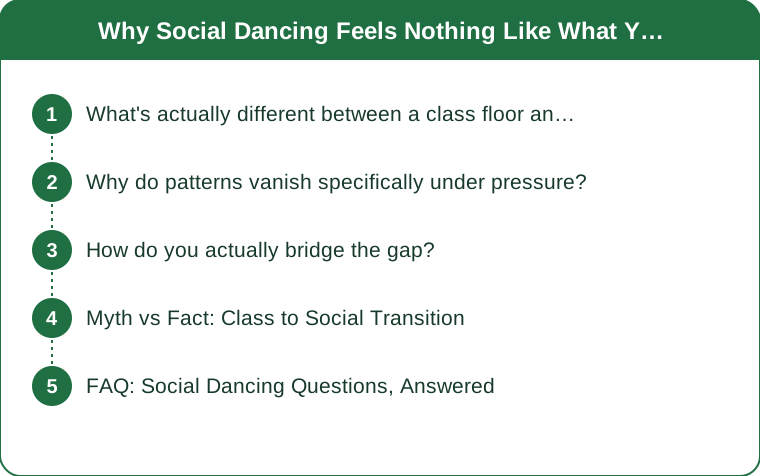
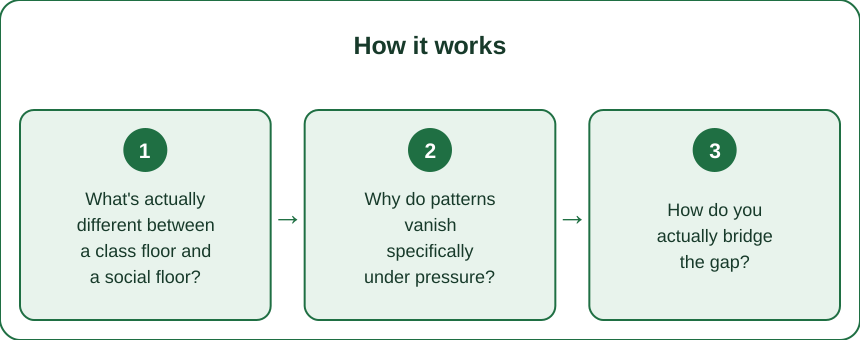
What’s actually different between a class floor and a social floor?
Five variables change at once, which is why the transition feels so abrupt.
Space. Class gives you a slot with clear boundaries. A busy social gives you maybe a third of that, with moving obstacles. Patterns that travel — anything with a cross-body element — need adaptation you were never taught.
Music. Class music is chosen for clarity: obvious clave, moderate tempo, consistent structure. Social DJs play what makes a room dance, which includes faster tracks, songs with breaks, and arrangements where the beat is genuinely harder to locate.
Partner familiarity. In class you rotate through people learning the identical thing. At a social, your partner learned in a different school, in a different style, possibly on a different count.
Lead clarity. Class leads are exaggerated because the instructor asks for exaggeration. Social leads are subtler, faster, and sometimes ambiguous.
No count. Someone counts you in during class, often through the whole pattern. Nobody counts at a social, and finding the one yourself in a loud room is a distinct skill that class rarely trains directly.
Why do patterns vanish specifically under pressure?
Because they were stored as sequences rather than as responses, and sequences are fragile.
A pattern learned in class is typically encoded as step 1, then 2, then 3. That works when nothing interrupts. But social dancing interrupts constantly — a bump, an unexpected tempo, a partner who doesn’t respond as expected — and an interrupted sequence has no recovery point. You’re back at the start, mid-song, with no start available.
What experienced social dancers have instead is a small set of responses tied to positions, not a large set of sequences. From any given position, they know two or three things that work. When something disrupts, they’re in some position, and something works from there.
Why more classes don’t fix this
Learning additional patterns adds more sequences to a system that fails for structural reasons. It’s the most common response to the class-to-social gap and one of the least effective. Three patterns you can enter and exit from anywhere are worth more than fifteen you can only run from the start — and that’s the entire difference between a class dancer and a social dancer.

How do you actually bridge the gap?
Practice the same material under progressively degraded conditions. Five steps, roughly in order.
Practice in a smaller space than you need. Literally mark out a smaller box and run your patterns inside it. This forces the compression that social floors require and teaches you which patterns can shrink.
Practice to unfamiliar music. Put on tracks you haven’t drilled to, including some faster than comfortable. Finding the one in unfamiliar music is the skill; drilling to the same three songs actively prevents developing it.
Practice starting mid-song. Class always starts at a musical beginning. Socials never do. Get comfortable joining at an arbitrary point.
Practice with deliberate errors. Have your practice partner intentionally miss a lead or step wrong. Then recover. This builds the recovery responses that sequences don’t contain.
Go early. Arriving in the first hour of a social means more space, more forgiving partners, and often a slower playlist. It’s the single most practical piece of advice for this transition and the one people most reliably ignore in favor of arriving when it’s busy.
Myth vs Fact: Class to Social Transition
Myth: You need more patterns before you’re ready for socials. Fact: You need fewer patterns, executed more robustly. Most experienced social dancers use a small core repertoire almost all night.
Myth: If you can’t follow a lead, the lead was bad. Fact: Sometimes. But following in a social context means responding to less information than class provides, and that’s a skill that develops with exposure.
Myth: Everyone else is dancing better than you. Fact: A busy floor looks far more accomplished than it is. Watch any single couple for a full song and you’ll see plenty of recovery, simplification, and repeated basics.
Myth: You should decline dances until you’re better. Fact: This is the most self-defeating belief in social dancing. The skill develops through social dancing specifically, so declining postpones the thing that fixes it.
Myth: Faster music means you should move faster. Fact: Experienced dancers simplify as tempo increases — fewer turns, smaller movements, more basic. Trying to run the same patterns faster is why fast songs feel impossible.
FAQ: Social Dancing Questions, Answered
How many socials before it starts feeling normal?
Most people describe a noticeable shift somewhere between six and twelve nights out. Frequency matters more than duration — weekly attendance for two months does more than monthly for a year.
What if I keep dancing with people much better than me?
Generally good for you, and most experienced dancers don’t mind at all. Say you’re newer at the start; good leads adjust immediately.
Should I learn on1 or on2 first?
Whichever your local scene predominantly dances. Being fluent in the local timing matters far more than which system is theoretically better.
How do I find the beat in a loud room?
Listen for the bass or the conga rather than the melody. On a very difficult track, standing still for eight counts before starting is completely acceptable and quite common.
Is it rude to keep it simple all night?
Not remotely. Clean basics with good connection are widely preferred over ambitious patterns executed shakily, and most experienced partners will tell you the same.
TL;DR:
- Class and social floors differ in space, music, partner familiarity, lead clarity, and counting
- Patterns fail because they’re stored as sequences with no recovery point
- Build a small set of responses you can enter and exit from any position
- Practice in less space, to unfamiliar music, starting mid-song, and with deliberate errors
- Arrive early, simplify on fast songs, and don’t decline dances while waiting to be ready
The gap between class and social isn’t a skill gap. It’s a conditions gap, and it closes by practicing under worse conditions rather than by learning more material.
Keep Reading
This article is for general informational and styling purposes only. Fit, sizing, and product availability may vary.