Why You Lose the Beat the Second the Salsa Music Speeds Up
Quick Answer: Losing the beat at faster tempos happens because beginners count steps consciously, and conscious counting has a speed ceiling — your brain simply can’t count fast enough at high tempo. The fix is training your body to feel the pattern rhythmically, not numerically, starting at a slow tempo specifically for this purpose.
At a slow, practice-friendly tempo, you nail the basic step every time — one, two, three, pause, five, six, seven, pause. Then the DJ plays something faster and suddenly you’re a beat behind, then two, then lost entirely. This isn’t a coordination problem. It’s a specific limit in how conscious counting works, and it has a clear fix.

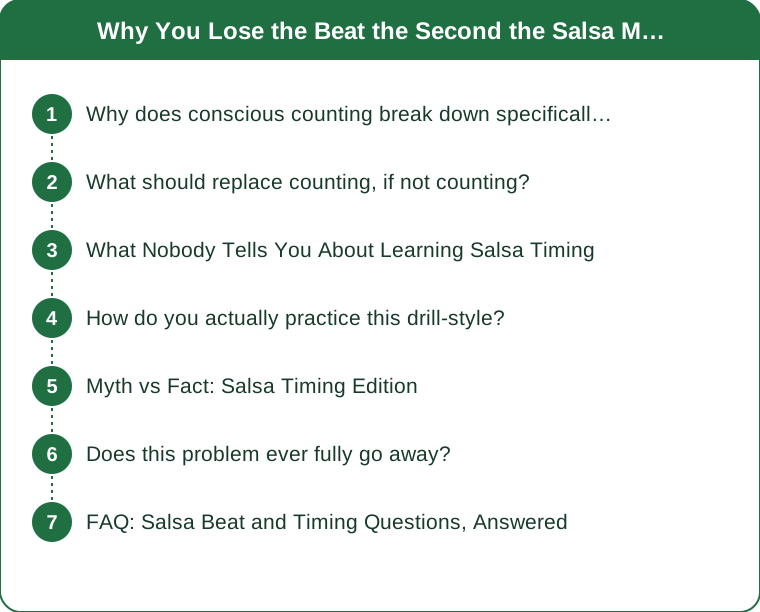
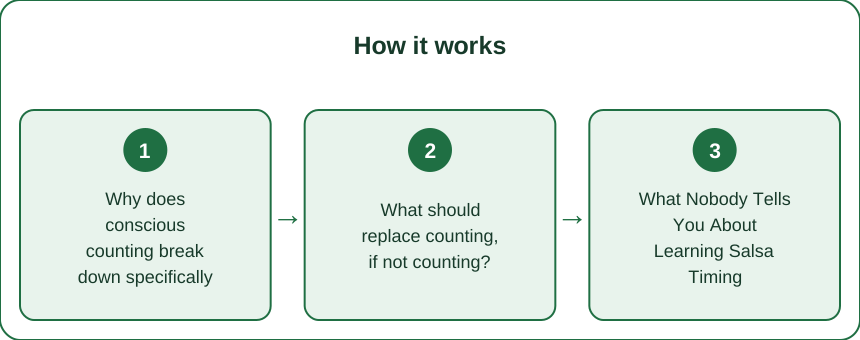
Why does conscious counting break down specifically at higher tempos?
Consciously counting ‘one-two-three’ while dancing uses the same mental bandwidth as doing basic arithmetic in your head — it works fine slowly, but there’s a hard ceiling on how fast a beginner brain can count while also managing balance, weight shift, and arm frame simultaneously.
At a slow tempo, you have enough spare mental capacity to count and move. Past a certain speed, the counting itself starts lagging behind the actual beats, and once the count is even slightly behind, every subsequent step compounds the error — which is exactly the ‘suddenly totally lost’ feeling.
What should replace counting, if not counting?
Feeling the pattern as a shape, not a number sequence. The basic salsa step has a physical rhythm — quick-quick-slow, quick-quick-slow — that can be felt in your feet and hips independent of counting numbers. Dancers who’ve moved past this stage aren’t secretly counting faster; they’ve stopped counting altogether and are responding to the music’s pulse directly.
This transition — from counting to feeling — is the single biggest jump in becoming tempo-independent, and it’s trainable specifically, not something that happens automatically with enough time on the floor.
What Nobody Tells You About Learning Salsa Timing
Here’s what most beginner classes don’t emphasize enough: you should deliberately practice the basic step slower than performance tempo, specifically to remove counting from the process, not just to learn the steps. Most people practice slow only long enough to learn where their feet go, then jump to normal-speed music — skipping the step where slow practice retrains the rhythm to be felt instead of counted.
The fix isn’t ‘practice more at fast tempo until it clicks.’ It’s ‘practice slow, without counting out loud or in your head, until the pattern feels automatic’ — then tempo stops mattering because you’re not doing conscious math anymore.

How do you actually practice this drill-style?
- Play a slow track (or count music slowed via an app) and do the basic step without counting at all — hum the rhythm instead, or say nothing, just feel where the weight shift happens
- Once that feels stable and automatic for 2-3 minutes straight, increase the tempo by one notch
- If you catch yourself counting again at the new tempo, drop back down one notch and repeat
- Progress in small tempo increments over multiple sessions, not one
This is slower progress than most people expect, often 2-3 weeks of dedicated practice rather than one class, but it’s the version that actually holds up on a crowded, fast social dance floor.
Myth vs Fact: Salsa Timing Edition
Myth: Faster dancers just count faster in their heads. Fact: Experienced dancers mostly aren’t counting at all during normal social dancing — they’re responding to felt rhythm, which is why tempo changes don’t rattle them.
Myth: More turn patterns will fix your timing problem. Fact: Adding complexity before timing is solid usually makes the timing problem worse, not better — it adds more things to consciously track on top of an already-overloaded counting process.
Myth: You just need more social dancing practice at full speed. Fact: Practicing at full speed while still counting reinforces the counting habit rather than replacing it — deliberate slow practice without counting is the actual fix.
Does this problem ever fully go away?
Yes, and usually faster than people expect once they specifically target it — most dancers who do dedicated slow, no-counting practice report a noticeable shift within a few weeks, going from ‘lost at fast tempo’ to ‘comfortable at fast tempo’ without a long plateau in between.
The dancers who stay stuck for months or years are usually the ones who kept practicing exclusively at performance tempo, reinforcing the same counting-under-pressure pattern that caused the problem in the first place.
FAQ: Salsa Beat and Timing Questions, Answered
Should I count out loud when I’m just starting out?
Yes, briefly — counting out loud for your very first sessions helps you learn where steps land. The key is deliberately weaning off it within a few classes, not counting indefinitely.
Why do I only lose the beat at parties, not in class?
Class music is often more consistent tempo and you have more mental bandwidth without social pressure; party settings add faster or shiftier tempo plus distraction, which is exactly when a counting-based habit breaks down.
Does dancing on1 vs on2 change this fix?
No — the counting-to-feeling transition applies to either timing style equally; the specific count numbers differ but the mental process of moving from counted to felt rhythm is the same.
TL;DR:
- Losing the beat at fast tempo is a counting ceiling, not a coordination failure
- The fix is practicing slow, without counting, until the pattern is felt not calculated
- Increase tempo in small steps, dropping back down if you catch yourself counting again
- Most dancers see real improvement within a few weeks of this specific drill
Your next practice session, try one full song of the basic step with zero counting, even slow — that’s the actual first step toward being tempo-proof.
Keep Reading
This article is for general informational and styling purposes only. Fit, sizing, and product availability may vary.