Why Salsa Feels Effortless With a Strong Lead - and What That Is Hiding
Quick Answer: An experienced lead provides clearer signals, better timing and often physical support that compensates for a follow’s balance gaps - so following feels easy. That is genuinely useful for learning what a move should feel like, but it also masks whether you can hold your own axis, find the beat independently, and recover from an unclear signal. Alternate deliberately: dance with strong leads to feel the target, and with less experienced ones to find out what you are actually doing.
Three songs with the best dancer in the room and you felt incredible.
Then the next partner, and it all fell apart. Both of those were information.

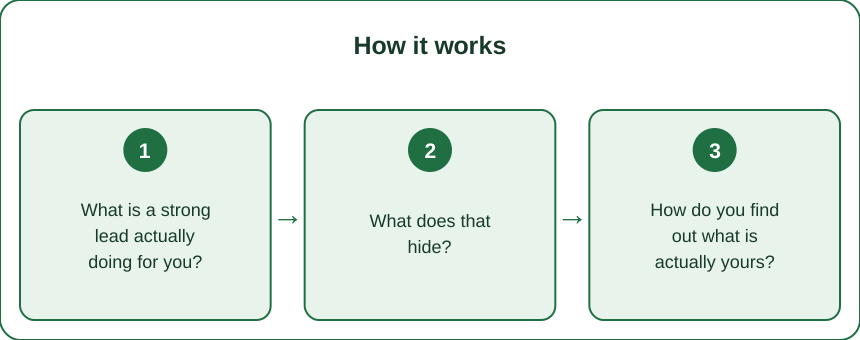
What is a strong lead actually doing for you?
Signalling earlier and more clearly, which gives you more time to respond and makes your timing look better than it is.
Providing a stable frame, which means you have something consistent to reference - and if your own balance wavers, the frame quietly absorbs it.
Adjusting to your level in real time, simplifying patterns and adapting timing without announcing it.
Managing the floor, so you are never navigating around other couples, which removes a substantial cognitive load you may not realise you carry.
Keeping the beat for both of you. If your own connection to the music is shaky, a strong lead’s timing carries you through the song.
And recovering errors invisibly, so mistakes that would derail a dance with a peer simply do not appear.
What does that hide?
Whether you can hold your own axis. If the frame is doing part of your balancing, you will not discover a balance problem until you dance with someone who cannot compensate.
Whether you can find the beat yourself, which is the most commonly borrowed skill and the one that vanishes first with a different partner.
Whether you can respond to an unclear signal, which is most of social dancing outside of experienced partners.
Whether your footwork is genuinely on time or is being pulled into time by the lead.
How much you are anticipating rather than following. With a familiar strong lead, patterns become predictable and you start moving before the signal, which does not transfer.
And whether you can recover. Dances with strong leads have fewer recoverable moments, so recovery is the skill you practise least.

How do you find out what is actually yours?
Dance alone to music for five minutes. Basic step, no partner, no counting out loud. If the beat drifts, that is your beat, not a partner problem.
Do a turn on your own and check where you finish. If you travel or wobble, the frame has been covering it.
Dance with a beginner deliberately, which is the clearest test available and is also good practice for both of you.
Close your eyes during your own basic and see whether your weight transfers cleanly - most balance issues are weight transfer issues rather than spinning issues.
Record thirty seconds on your phone, which is uncomfortable and enormously informative.
And notice which songs you struggle with. Faster tempos expose timing that slower ones hide.
Myth vs Fact: Learning From Better Dancers
Myth: you improve fastest by only dancing with better dancers. Fact: you improve fastest by mixing. Better dancers show you the target; peers and beginners reveal what you can actually do without support.
Myth: if a dance felt good, you danced well. Fact: a dance feeling good is largely evidence about your partner. It is a wonderful experience and a poor self-assessment.
Myth: a follow’s job is to be light and passive. Fact: a good follow maintains their own axis, their own timing and a consistent frame. Passivity puts all the balance work on the lead and produces exactly the dependency described here.
Myth: struggling with a weaker lead means you are not progressing. Fact: it means you are being tested on the parts a strong lead was covering. That struggle is where the actual learning happens.
Myth: more turn patterns is progress. Fact: for most dancers, adding patterns before the basic timing and balance are independent is what makes social dancing feel chaotic. Patterns are the visible part; timing and axis are the load-bearing part.
Myth: counting out loud helps forever. Fact: it is a useful scaffold early and becomes a limitation later, because it keeps your attention on numbers rather than on the music and your partner.
FAQ: Salsa Lead and Follow Questions, Answered
Why do I dance so much better with certain partners?
Experienced leads signal earlier, provide a stable frame, keep the beat and recover errors invisibly. Some of what feels like your improvement is their support.
Should I only dance with better dancers?
No. Mix deliberately. Better dancers teach you what a move should feel like; peers and beginners reveal what you can do unsupported.
How do I test my own timing?
Dance your basic alone to music with no counting for five minutes. Any drift is yours. A phone recording is even more revealing.
Why do my turns fall apart with some partners?
Usually because your own axis is not independent yet and a strong frame was compensating. Practise turns alone and check where you finish.
Is it rude to dance with beginners?
Not at all - it is normal, generous, and genuinely the best diagnostic you have for your own skills.
Why does faster music expose problems?
Because less time between beats means less room to correct. Timing that is slightly late at a slow tempo becomes visibly late at a fast one.
TL;DR:
- A strong lead signals earlier, stabilises the frame, keeps the beat and hides your errors.
- That feels like sudden improvement and is partly a loan.
- What gets hidden: your own axis, your independent timing, and your ability to recover.
- Test yourself by dancing your basic alone, turning alone, and recording thirty seconds.
- Dance with beginners deliberately - it is the clearest diagnostic available.
- Faster tempos expose timing that slow ones conceal.
Dance with strong leads to feel the target, and with everyone else to find out what is actually yours.
Keep Reading
This article is for general informational and styling purposes only. Fit, sizing, and product availability may vary.