Why Your Salsa Feels Worse After a Few Weeks of Classes, Not Better
Quick Answer: Around four to eight weeks in, most beginners feel like they are getting worse. What has actually happened is that your ear and eye have improved faster than your feet — you can now hear the beat you are missing and see the tension in your own frame. The felt regression is a perception upgrade, and pushing into more complex patterns at that point makes it worse rather than better.
Week two, you felt great. Week six, you feel like you have forgotten how to walk. Your teacher says you are improving, which is either kind or delusional, and you cannot tell which.

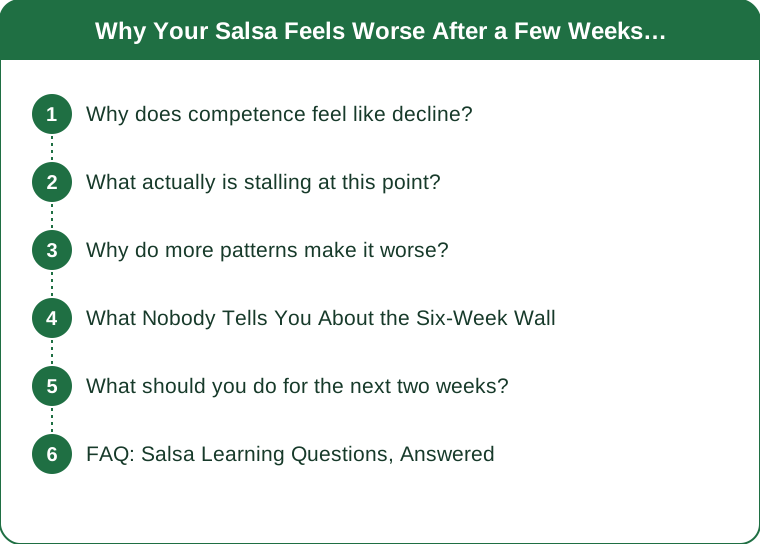
Why does competence feel like decline?
Because two things improve at different speeds, and the faster one is the one that judges the slower one.
Perception improves quickly. Within a few weeks of listening to salsa music with intent, most people can hear the clave, identify the one, and notice when a step arrives late. That is a genuine and fast-developing skill.
Motor execution improves slowly. Getting a weight shift to happen at the right millisecond takes months of repetition, because it involves building a motor pattern rather than acquiring information.
So at week six you have a good ear attached to feet that have not caught up. You are now able to detect every error you were already making, which feels exactly like getting worse and is the opposite.
The useful test: record yourself in week one and week six. Almost nobody who does this concludes they got worse. The tape and the feeling disagree, and the tape is right.
What actually is stalling at this point?
Usually one specific thing, and it is almost never the footwork.
Weight transfer. Beginners learn steps as foot placements — put this foot here, then that foot there. Salsa is actually about where your weight is, and the foot position is a consequence. A step where the foot arrives on time but the weight arrives late reads as off-beat to everyone including you, and no amount of footwork practice fixes it, because footwork is not the problem.
Frame tension. The second most common. Beginners either go rigid, which makes them impossible to lead, or go soft, which makes them impossible to lead. Both come from thinking about the arms. Frame comes from the back and the ribcage; the arms are just the visible part.
Rushing the recovery step. The step you take to come back is where timing gets lost, because it feels less important than the step you take forward. It is not.
If the plateau feels total, it is almost certainly one of these three, and identifying which one is far more useful than practicing everything harder.
Why do more patterns make it worse?
Because pattern acquisition and timing quality are in direct competition for attention.
When you are running a pattern you barely know, essentially all of your working attention goes to remembering what comes next. There is nothing left for the beat, the weight shift, or the connection, which are the three things that actually determine whether the dance works.
The result is a dancer who knows twenty patterns and executes all of them slightly late with a stiff frame — which is a recognizable and very common type in social dancing, and a frustrating place to be, because the pattern count suggests progress that the dancing does not deliver.
The counterintuitive fix is to practice fewer patterns more. Take three you already know and run them until they require no attention at all. Only then does attention become available for timing and connection, and only then does adding a fourth pattern make you better rather than busier.
This is unpopular advice because classes are structured around new material, and new material is more fun than repetition. It is still the fastest route through the plateau.

What Nobody Tells You About the Six-Week Wall
Everyone hits it, and nobody mentions it. It is close to universal in partner dance and it arrives on a fairly predictable schedule, which is itself the evidence that it is a developmental stage rather than a personal failure.
Social dancing feels dramatically harder than class, and that is not a sign you are behind. Class has a known pattern, a consistent count, and a partner who knows what is coming. Social dancing has none of those. They are genuinely different skills, and being good at one does not transfer automatically.
Your partners are not judging your pattern count. Experienced social dancers overwhelmingly prefer a partner with three patterns, good timing, and a comfortable frame over one with twenty patterns and neither. This is close to unanimous and beginners consistently believe the opposite.
The plateau breaks suddenly rather than gradually. Motor learning tends to consolidate in steps rather than smoothly, often after sleep and often after a period of no apparent progress. The week where everything suddenly works is a real phenomenon and it usually arrives without warning.
Taking a week off sometimes helps. Not always, but consolidation happens during rest, and people who have been drilling hard for six weeks and feel worse are sometimes just fatigued and over-focused.
The people who quit almost all quit here. Not at week one, when it is hard and fun. At week six, when it is hard and feels like failure. Knowing that this is the standard shape of it is genuinely most of what gets people through it.
What should you do for the next two weeks?
A specific, small program that addresses the actual bottleneck.
- Practice the basic step alone, to music, for five minutes a day. No patterns. Just the basic, with full attention on where your weight is at each count. This is the single highest-return practice available and almost nobody does it
- Count out loud while you dance. Awkward in class, transformative in private practice. Speaking the count forces you to reconcile what you hear with what you do
- Pick three patterns and retire the rest temporarily. Run those three until they are automatic
- Practice the frame against a wall or a door frame. Press gently and feel where the resistance comes from. If it comes from your arm, that is the fault; it should come from your back
- Go social dancing anyway, and go with the goal of dancing three songs well rather than performing everything you know. The gap between class and social dancing closes only through social dancing
And the mindset shift that does most of the work: you are not trying to get better at salsa this month. You are trying to make the basic step automatic, and everything else in the dance is built on top of that one thing. The people who feel like it clicked around month four are almost always the ones who spent month two doing the boring version.
FAQ: Salsa Learning Questions, Answered
How long until social dancing stops being terrifying?
Most people report a meaningful shift somewhere between two and four months of dancing socially at least a couple of times a month. The variable that matters most is frequency of social dancing, not class attendance — the anxiety is a familiarity problem, and familiarity only builds in the actual environment.
Should I switch teachers if I have stalled?
Probably not at six weeks. The plateau is developmental and arrives regardless of teacher. If you are still stuck at four to five months with no change in what is being addressed, that is a more reasonable time to consider it — or to add a few private lessons, which are unusually effective for timing and frame problems because those are hard to diagnose in a group.
Is it normal to be much better with some partners than others?
Completely, and it stays that way at every level. Connection is a two-person system, and lead-follow compatibility varies. What changes with experience is your ability to adapt quickly to an unfamiliar partner, which is itself a distinct skill and one of the last to develop.
TL;DR:
- The week-six slump is your perception improving faster than your motor skill, not a regression
- The real bottleneck is almost always weight transfer, frame tension, or a rushed recovery step
- More patterns make it worse because pattern recall competes with timing for attention
- Drill the basic step alone to music for five minutes a day and retire everything but three patterns
The plateau is the point where most people quit and the point where the actual learning is happening. Recognizing it as a stage rather than a verdict is most of what gets you to the other side of it.
Keep Reading
This article is for general informational and styling purposes only. Fit, sizing, and product availability may vary.