Why Your Shoes Change Your Salsa More Than Another Month of Classes
Quick Answer: Salsa is a pivot-based dance, and pivots are governed by the friction between your sole and the floor. Sneakers are engineered to prevent exactly the rotation salsa requires — their grippy rubber makes every turn a fight that ends in a hop, a wobble, or a twisted knee. A suede-soled dance shoe, or even a smooth-bottomed street shoe, changes your turns the day you put it on, which is why teachers watch beginners transform mid-class after a shoe swap. Before you conclude you are bad at turning, audit what is between you and the floor.
Here is the friction story, what to buy at each stage, and what it will and will not fix.
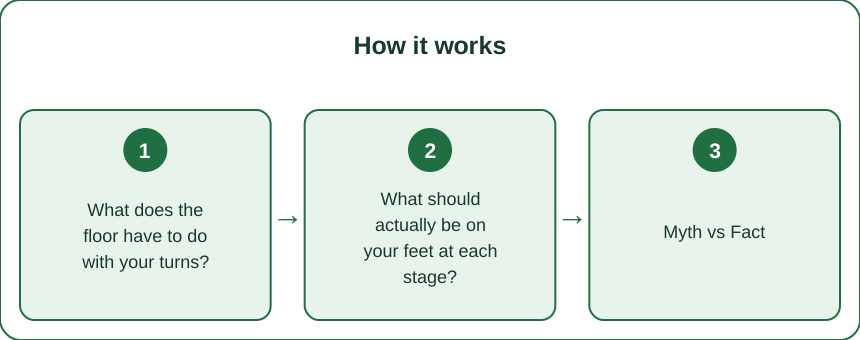
What does the floor have to do with your turns?
Everything, because a turn is physically a controlled slip.
A salsa turn works by placing the ball of one foot on the floor and rotating your entire body mass over that single small contact point. For that to happen smoothly, the sole must slide rotationally against the floor — a pivot is friction low enough to allow spinning, high enough that you do not skate away. Dance happens inside that narrow band.
Running shoes are engineered for the opposite goal. Their soles exist to maximize grip — soft rubber compounds, tread patterns, wide flat contact areas — because in running, any slip is failure. Put that engineering into a spin and the shoe does its job perfectly: it refuses to rotate. Your foot stops; your momentum does not.
What happens next is the beginner-turn catalog. The hop-around turn — you lift and re-place your foot in three little jumps because pivoting was impossible. The stuck-and-wobble — your body rotates over a planted foot until you run out of range and fall off balance. And the quietly dangerous one: torque that cannot escape at the floor travels up the leg, which is why knees complain after sneaker-heavy dance nights. The rotation has to happen somewhere, and a knee is a terrible substitute for a sole.
Meanwhile the same grippy sole muffles the rest of the dance: weight transfers feel sticky, quick foot repositions catch, and the smooth ball-change texture of salsa footwork turns into a series of small peels. Beginners read all this as their own clumsiness. A fair share of it is rubber doing exactly what rubber was designed to do.
What should actually be on your feet at each stage?
A progression, not a single purchase — and stage one is free.
Stage one: smooth-soled shoes you already own. For the first classes, anything with a smooth, hard-ish bottom beats any sneaker: loafers, low boots with leather soles, flats with minimal tread. The test takes five seconds at home — stand on a hard floor on the ball of one foot and try to pivot a quarter turn. If it swivels without your knee complaining, it will teach you turns better than your gym shoes will.
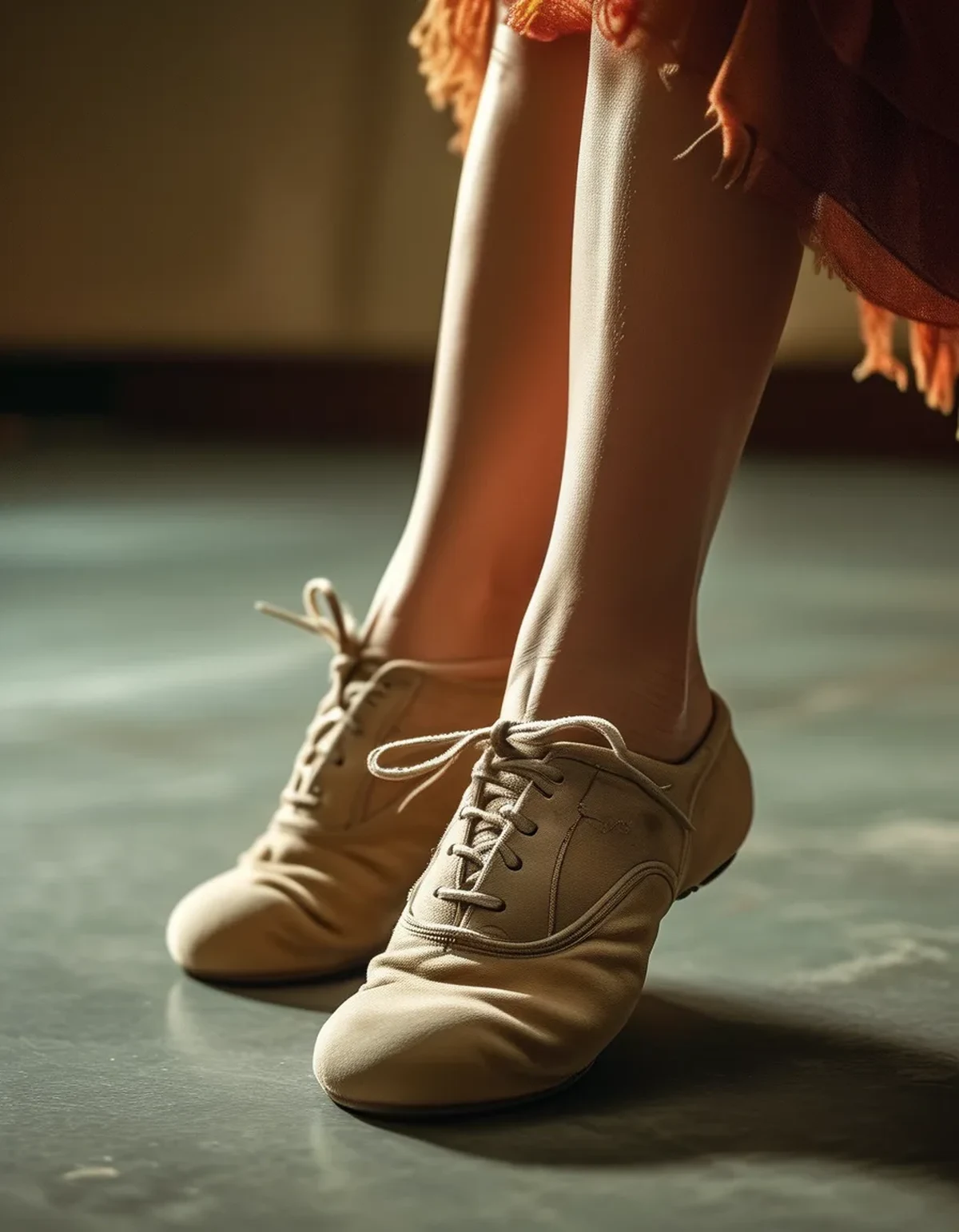
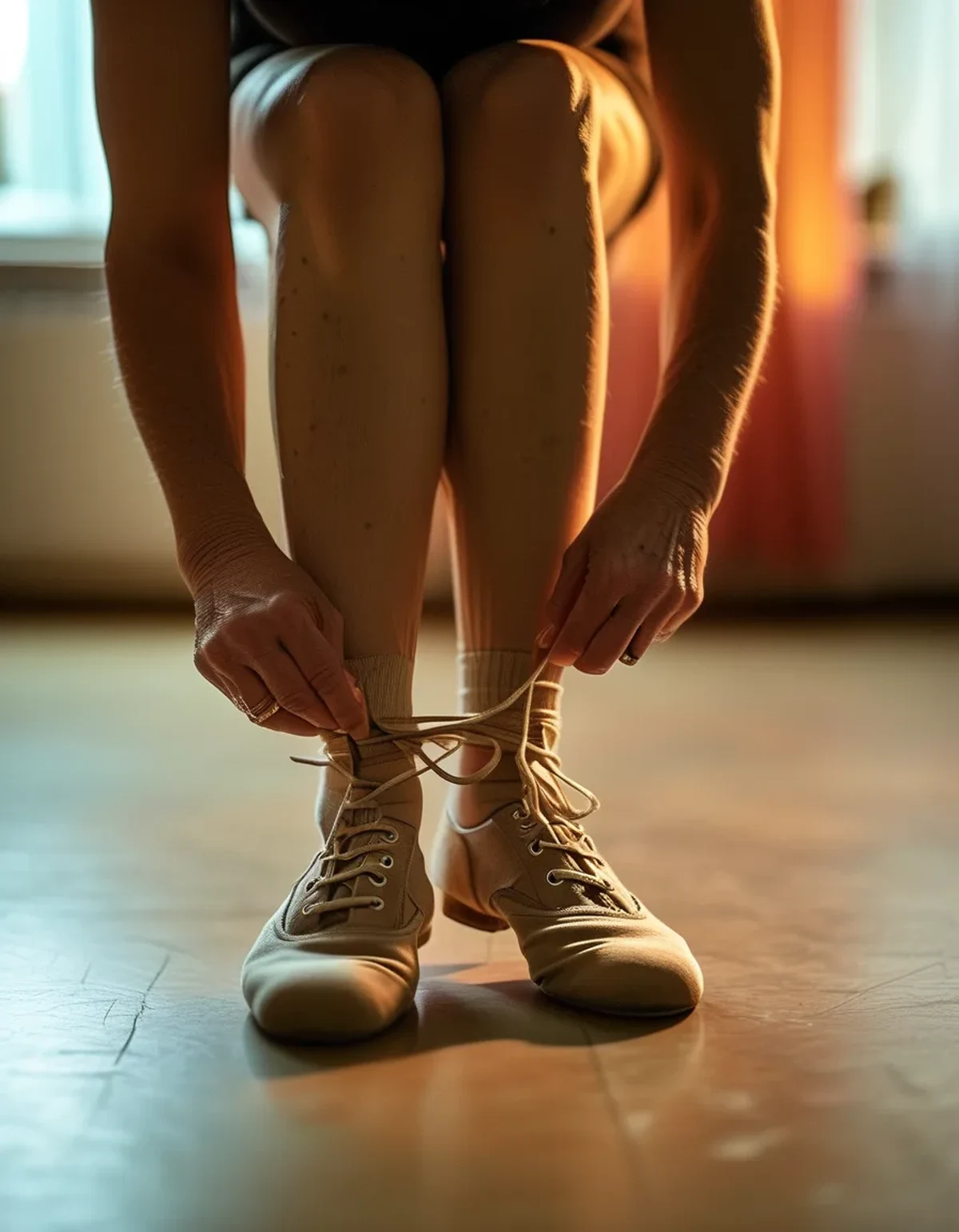
Stage two: suede-soled dance shoes, once you know you are staying. Suede — technically chrome leather — is the dance standard because brushed suede sits in the perfect friction band on wood: it pivots freely and still lets you push off. Entry pairs cost about the same as a couple of class drop-ins, and the first night in them is a revelation most dancers remember specifically. For salsa, look for a flexible sole you can feel the floor through, a secure strap so the shoe turns when your foot does, and — for heels — the weight balanced forward over the ball, since salsa lives on the balls of the feet.
Heels are optional, and height is a choice, not a requirement. A 2 to 2.5 inch flared heel is the common social standard, but low practice heels and flat jazz-style dance sneakers with spin spots are fully legitimate — plenty of excellent dancers social-dance in them for entire congresses. Comfort that lasts four songs beats elegance that lasts one.
What to wear with them matters less, with one exception: your hems. Wide-legged pants that pool over the shoe catch under your own pivot foot mid-turn. This is why studio wardrobes converge on fitted bottoms — leggings, or flare leggings that flare below the calf rather than at the floor — clothes that move like you do and never introduce a second friction problem on top of the one you just solved.
And protect the suede. Suede soles are for dance floors only — one walk across a parking lot grinds in grit and glazes them. Carry them in, change at the edge of the floor like everyone else, and brush the soles with a wire shoe brush when they go shiny. The changing-at-the-bench ritual is not preciousness; it is maintenance.
Myth vs Fact: Dance Shoes
Myth: good dancers can turn in anything. Fact: experienced dancers can compensate in anything for a song — and they still carry their shoes to every social, which tells you what the compensation costs. Beginners have no compensation bank to draw on, which is exactly why shoes change beginners the most.
Myth: more cushioning is better for a long dance night. Fact: thick soft midsoles put a wobbly platform between you and the floor, blur the floor feedback salsa timing depends on, and raise the pivot resistance. Dance shoes are thin on purpose — closeness to the floor is the feature. Sore feet after long nights are usually a fit or technique issue, not a padding shortage.
Myth: suede is slippery and dangerous. Fact: on a proper wood floor, brushed suede is the calibrated middle — it slides rotationally and grips linearly, which is the entire trick. What is actually dangerous is mismatched friction: rubber on wood for turns, or worn-glassy suede on a dusty floor. Maintenance, not material, is the safety variable.
Myth: you need heels to dance salsa properly. Fact: heels shift weight forward, which suits the dance, but flats, practice heels, and dance sneakers accomplish the same posture with training. Follows in flat jazz shoes dance every style at every level. The requirement is a pivot-capable sole and a secured heel — the height is aesthetics and preference.
Myth: dance shoes should feel comfortable like sneakers immediately. Fact: they should feel snug like a firm handshake — suede uppers stretch and mold within a few wears, and a shoe that starts roomy ends sloppy, which means your foot turns inside the shoe instead of the shoe turning on the floor. Secure now, custom-fit in a month.
What will shoes fix, and what stays on you?
A fair accounting, because the right shoes are a door, not a dance.
Fixed almost immediately: the mechanics of pivoting. Turns stop being hops, weight transfers smooth out, the ball-of-foot texture of the basic step becomes physically available, and your knees stop absorbing rotation. Most dancers feel this inside one class, and it is the single biggest per-dollar upgrade in the sport.
Improved but not solved: spotting, posture, and balance. With the floor no longer fighting you, your balance problems become visible instead of masked — which is progress, though it rarely feels like it that night. A clean pivot under a tilted posture is still a fall; the shoe just clarifies whose fault it was.
Untouched entirely: timing, connection, and repertoire. Shoes do not hear the clave, read a lead, or remember what comes after the cross-body. The month of classes the title disparaged is still necessary — the point is sequencing. A month of classes in sneakers teaches you to fight your equipment; the same month in real shoes teaches you to dance. Buy the shoes early precisely so the classes pay full rate.
One honest caveat about floors, because the shoe is only half the friction equation: the same suede that glides on studio wood drags on concrete patios and skates on dusty tile. Social dancing happens on all of them. Experienced dancers develop a thirty-second floor check — a discreet test pivot near the edge — and adjust turn ambition to what the surface offers. Learning to read floors is a genuine skill, and it starts the day you own shoes consistent enough to make the floor the only variable.
If class budget forces a choice this month: smooth-soled shoes you own plus classes beats new dance shoes and no classes. But the first spare thirty to sixty dollars after that has one correct destination.
FAQ: Salsa Shoe Questions, Answered
Can I just dance in socks at home to practice turns?
For turn drills on smooth floors, socks are genuinely useful — friction low enough to teach the feeling of a free pivot. They are too slippery for full-speed dancing and teach nothing about pushing off, so treat them as a practice tool, not a substitute.
How do I know when my suede soles need brushing?
When they look shiny or feel slick on a floor that used to feel right. Glazed suede is compacted fibers — a firm pass with a wire dance-shoe brush raises the nap and restores the calibrated friction. Weekly for regular dancers, and always after a dusty floor.
Are dance sneakers cheating?
Not remotely. Good ones have split soles for pointing, spin spots under the ball for pivots, and no-grip rubber compounds — they are dance shoes wearing a sneaker costume. For long socials, tall dancers, and anyone protecting knees or backs, they are often the smartest option in the bag.
What is one thing to check before buying my first pair?
That the shoe rotates with your foot: hold the heel and twist the toe — a floppy shank that lets the shoe wring like a towel means your pivot energy dies inside the shoe. You want flexibility toe-to-heel for pointing, and reasonable torsional integrity so foot and shoe turn as one unit.
TL;DR:
- A turn is a controlled slip: salsa needs rotational friction low enough to pivot, and sneaker rubber is engineered to forbid exactly that.
- Progression: smooth-soled shoes you own for the first classes, then suede-soled dance shoes — snug fit, secure strap, weight balanced over the ball.
- Suede lives on dance floors only: carry them in, change at the bench, brush the soles when they glaze.
- Shoes fix pivot mechanics overnight; timing, connection, and balance still cost classes — the shoes just make every class count double.
Before your next class, do the five-second pivot test on everything in your closet. The pair that swivels is your dance shoe until the real ones arrive — and the turn you have been failing may work this week.
See It in Motion
Seen here: Super High Waist Embossed Yoga Leggings with Inner Pocket — shop it on bubblelime.com
Keep Reading
This article is for general informational and styling purposes only. Fit, sizing, and product availability may vary.